
IRSTI 76.29.19/10.85.31
UDC 340.624.3
Utegenova Gulshat Amandykovna — graduate student of the department of criminal law and criminology of the law Institute of the Kyrgyz National University named after J. Balasagyn (Kyrgyz Republic, Bishkek);
Seipilov Askar Mustakhimovich — forensic expert of the branch of the «RSOE Center for Forensic Examinations of the Ministry of Justice of the Republic of Kazakhstan» Institute of forensic examinations in Astana (Republic of Kazakhstan, Astana);
Mediyev Renat Amangeldyevich — leading researcher at the center for criminal procedure research, Interdepartmental scientifically-research institute of the Academy of Law Enforcement Agencies under the General Prosecutor’s Office of the Republic of Kazakhstan, doctor PhD, associate professor (Republic of Kazakhstan, Koshy)
ELECTRONIC MEDICAL RECORDS AS A TOOL FOR FORENSIC MEDICAL EXAMINATION OF BODILY INJURIES IN CASES OF DOMESTIC VIOLENCE
Annotation. With the digitalization of healthcare in Kazakhstan, electronic medical records are gradually becoming the primary tool for storing and transmitting medical data, including information about physical injuries caused by domestic violence. However, forensic medical examination practice shows that there are often discrepancies between the records in electronic records and the results of expert examinations, which raises doubts about their completeness and legal significance. Given the increase in the number of cases of domestic violence and public attention to the protection of victims, the question of the evidential value of electronic medical records is becoming particularly relevant. The purpose of the study is to assess the significance, reliability, and practical value of electronic medical records as a source of information in the forensic medical assessment of bodily injuries caused by domestic violence, as well as to identify the key barriers to their effective use in forensic practice in Kazakhstan. The work was carried out in the format of a retrospective analytical study. The material consisted of 1,462 forensic medical examinations conducted in Astana in 2022-2024 and during the first seven months of 2025. For each case, electronic medical records were analyzed: the completeness of the records, their consistency with the expert’s conclusions, the presence of time stamps, and accompanying documentation were checked. Descriptive statistics and correlation analysis methods were used. Results. It was found that in 36,1 % of the examinations, there were discrepancies between the data in the electronic record and the expert’s conclusion. In 40 % of cases, the documentation was incomplete, which complicated the correct classification of injuries. A positive correlation was established between the structure of the electronic record and the quality of expert conclusions. Electronic medical records have significant potential as a source of evidence for forensic medicine. However, the heterogeneity of information systems, the lack of uniform standards for maintenance, and the insufficient digital competence of medical workers significantly reduce their practical value. To increase efficiency, it is necessary to unify the requirements for maintaining electronic records, taking into account the tasks of forensic medical examination, and to ensure the training of medical personnel in the field of legally significant documentation.
Keywords: electronic, informatization, standardization, documentation, medicine, trauma, violence, expertise, jurisprudence, evidence.
Өтегенова Гүльзат Амандыққызы — Ж. Баласағын атындағы Қырғыз ұлттық университеті заң институтының қылмыстық құқық және криминология кафедрасының аспиранты (Қырғыз Республикасы, Бішкек қ.);
Сейпилов Асқар Мұстахимұлы — ҚР Әділет министрлігінің «РМҚК Сот сараптамалары орталығы» филиалының Астана қаласы бойынша сот сараптамалары институтының жоғары біліктілік санатты сот-медициналық сарапшысы (Қазақстан Республикасы, Астана қ.);
Медиев Ренат Амангельдіұлы — Қазақстан Республикасы Бас прокуратурасы жанындағы Құқық қорғау органдары академиясының Ведомствоаралық ғылыми-зерттеу институты қылмыстық процесс проблемаларын зерттеу орталығының жетекші ғылыми қызметкері, PhD докторы, қауымдастырылған профессор (доцент) (Қазақстан Республикасы, Қосшы қ.)
ЭЛЕКТРОНДЫҚ МЕДИЦИНАЛЫҚ КАРТАЛАР ОТБАСЫЛЫҚ-ТҰРМЫСТЫҚ ЗОРЛЫҚ-ЗОМБЫЛЫҚ КЕЗІНДЕ ДЕНЕ ЖАРАҚАТЫН СОТ-МЕДИЦИНАЛЫҚ САРАПТАУ ҚҰРАЛЫ РЕТІНДЕ
Түйін. Қазақстанның денсаулық сақтау саласын цифрландыру жағдайында электрондық медициналық карталар отбасылық-тұрмыстық зорлық-зомбылық кезіндегі дене жарақаттары туралы мәліметтерді қоса алғанда, медициналық деректерді сақтау мен берудің негізгі құралына айналуда. Бұл ретте сот-медициналық сараптама практикасы мынаны көрсетеді: электрондық карталардағы жазбалар мен сараптамалық тексеру нәтижелері арасындағы сәйкессіздіктер жиі тіркеледі, бұл олардың толықтығы мен заңды маңыздылығына күмән тудырады. Тұрмыстық зорлық-зомбылық жағдайларының көбеюін және қоғамның зардап шеккендерді қорғауға назарын ескере отырып, электрондық медициналық карталардың дәлелді әлеуеті туралы мәселе ерекше өзекті болып отыр. Зерттеудің мақсаты отбасылық-тұрмыстық зорлық-зомбылықтан туындаған дене жарақаттарын сот-медициналық бағалау кезіндегі мәліметтер көзі ретінде электрондық медициналық карталардың маңыздылығын, дұрыстығын және практикалық құндылығын бағалау, сондай-ақ оларды Қазақстанның сот-сараптамалық практикасында тиімді қолданудың негізгі кедергілерін анықтау болып табылады. Жұмыс ретроспективті аналитикалық зерттеу форматында орындалды. Материал 2022-2024 жылдары Астанада және 2025 жылдың 7 айында жүргізілген 1462 сот-медициналық сараптама болды. Әрбір жағдай үшін электрондық медициналық карталар талданды: жазбалардың толықтығы, олардың сарапшының қорытындыларына сәйкестігі, уақыт белгілері мен ілеспе құжаттаманың болуы тексерілді. Сипаттамалық статистика және корреляциялық талдау әдістері қолданылды. Сараптамалардың 36,1 % электрондық картадағы деректер мен сарапшының қорытындысы арасында сәйкессіздіктер байқалғаны анықталды. 40 % жағдайда құжаттама толық болмады, бұл зақымданудың дұрыс біліктілігін қиындатты. Электрондық картаның құрылымдылығы мен сараптамалық қорытындылардың сапасы арасында оң корреляция анықталды. Электрондық денсаулық жазбалары сот медицинасы үшін дәлелді ақпарат көзі ретінде айтарлықтай әлеуетке ие. Алайда, ақпараттық жүйелердің гетерогенділігі, бірыңғай басқару стандарттарының болмауы және медицина қызметкерлерінің цифрлық құзыреттілігінің жеткіліксіздігі олардың практикалық құндылығын айтарлықтай төмендетеді. Тиімділікті арттыру үшін сот-медициналық сараптаманың міндеттерін ескере отырып, электрондық карталарды жүргізуге қойылатын талаптарды біріздендіру және заңдық маңызы бар құжаттама саласында медициналық персоналды даярлауды қамтамасыз ету қажет.
Түйінді сөздер: электрондық, ақпараттандыру, стандарттау, құжаттама, медицина, жарақат, зорлық-зомбылық, сараптама, құқықтану, дәлелдемелер.
Утегенова Гульзат Амандыковна — аспирант кафедры уголовного права и криминологии Юридического института Кыргызского Национального университета имени Ж. Баласагына (Кыргызская Республика, г. Бишкек);
Сейпилов Аскар Мустахимович — судебно-медицинский эксперт филиала «РГКП Центр судебных экспертиз МЮ РК» Институт судебных экспертиз по городу Астана (Республика Казахстан, г. Астана);
Медиев Ренат Амангельдыевич — ведущий научный сотрудник Центра исследования проблем уголовного процесса Межведомственного научно-исследовательского института Академии правоохранительных органов при Генеральной прокуратуре Республики Казахстан, доктор PhD, ассоциированный профессор (доцент) (Республика Казахстан, г. Косшы)
ЭЛЕКТРОННЫЕ МЕДИЦИНСКИЕ КАРТЫ КАК ИНСТРУМЕНТ СУДЕБНО-МЕДИЦИНСКОЙ ЭКСПЕРТИЗЫ ТЕЛЕСНЫХ ПОВРЕЖДЕНИЙ ПРИ СЕМЕЙНО-БЫТОВОМ НАСИЛИИ
Аннотация. В условиях цифровизации здравоохранения Казахстана электронные медицинские карты постепенно становятся основным инструментом хранения и передачи медицинских данных, включая сведения о телесных повреждениях при семейно-бытовом насилии. При этом практика судебно-медицинской экспертизы показывает: нередко фиксируются несоответствия между записями в электронных картах и результатами экспертного обследования, что вызывает сомнения в их полноте и юридической значимости. Учитывая рост числа случаев бытового насилия и внимание общества к защите пострадавших, вопрос о доказательном потенциале электронных медицинских карт приобретает особую актуальность. Целью исследования является оценка значимости, достоверности и практическая ценность электронных медицинских карт как источника сведений при судебно-медицинской оценке телесных повреждений, вызванных семейно-бытовым насилием, а также выявление ключевых барьеров их эффективного применения в судебно-экспертной практике Казахстана. Работа выполнена в формате ретроспективного аналитического исследования. Материалом послужили 1462 судебно-медицинские экспертизы, проведенные в Астане в 2022-2024 годах и за 7 месяцев 2025 года. Для каждого случая анализировались электронные медицинские карты: проверялась полнота записей, их соответствие выводам эксперта, наличие временных меток и сопутствующей документации. Использовались методы описательной статистики и корреляционного анализа. В результате было выявлено, что в 36,1% экспертиз наблюдались расхождения между данными в электронной карте и заключением эксперта. В 40% случаев документация оказалась неполной, что усложняло правильную квалификацию повреждений. Установлена положительная корреляция между структурированностью электронной карты и качеством экспертных заключений. Электронные медицинские карты обладают значительным потенциалом как источник доказательной информации для судебной медицины. Однако разнородность информационных систем, отсутствие единых стандартов ведения и недостаточная цифровая компетентность медицинских работников заметно снижают их практическую ценность. Для повышения эффективности необходимо унифицировать требования к ведению электронных карт с учетом задач судебно-медицинской экспертизы и обеспечить подготовку медицинского персонала в сфере юридически значимой документации.
Ключевые слова: электронная, информатизация, стандартизация, документация, медицина, травма, насилие, экспертиза, юриспруденция, доказательства.
Introduction. With the rapid digitalization of healthcare, electronic medical records (hereinafter referred to as EMRs) are becoming an indispensable tool in clinical practice, administration, and expert assessment of medical information. In the post-Soviet space, including the Republic of Kazakhstan, the introduction of EMRs is one of the priorities of state policy in the field of digital healthcare, as outlined in Kazakhstan’s Digital Transformation Concept[1].
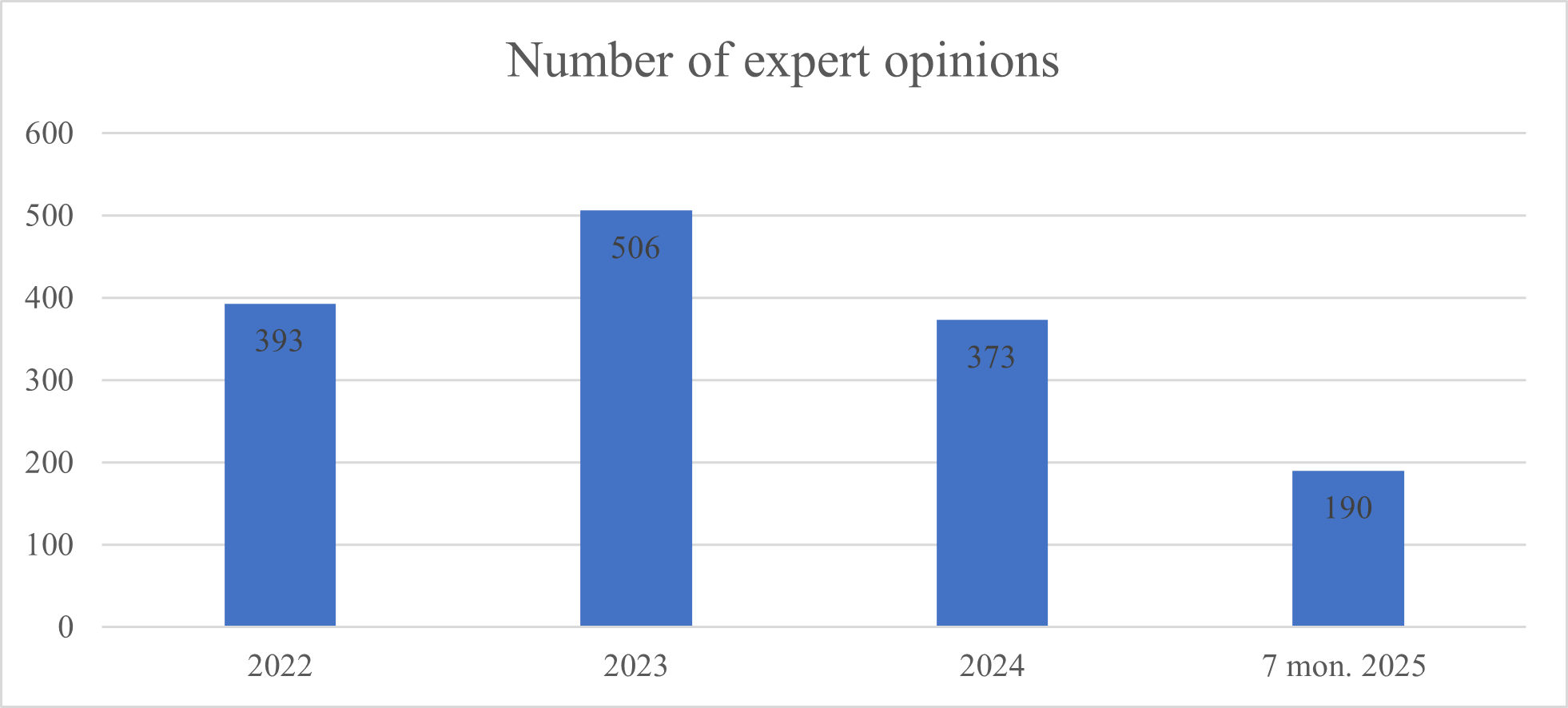
One of the acute social and medical-legal problems facing modern Kazakh society remains domestic violence[2]. According to data from the Forensic Examination Center of the Ministry of Justice of the Republic of Kazakhstan (hereinafter referred to as the FEC MJ of the Republic of Kazakhstan), 393 examinations related to domestic violence were conducted in Astana in 2022, 506 examinations in 2023, in 2024 – 373 examinations, and in the first 7 months of 2025 — 190 examinations (see Fig. 1).
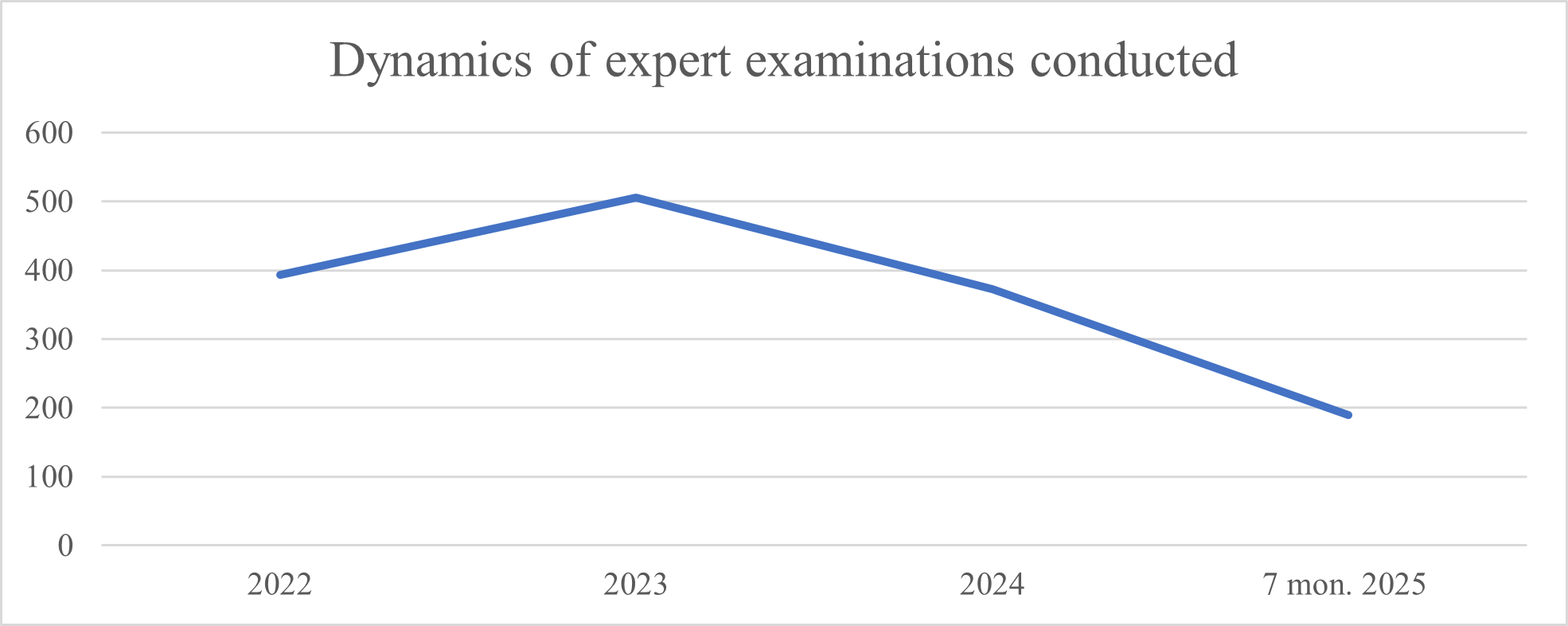
The dynamics of expert examinations conducted in relation to domestic violence in Astana for the entire period under review amounted to 83.0% (see Fig. 2).
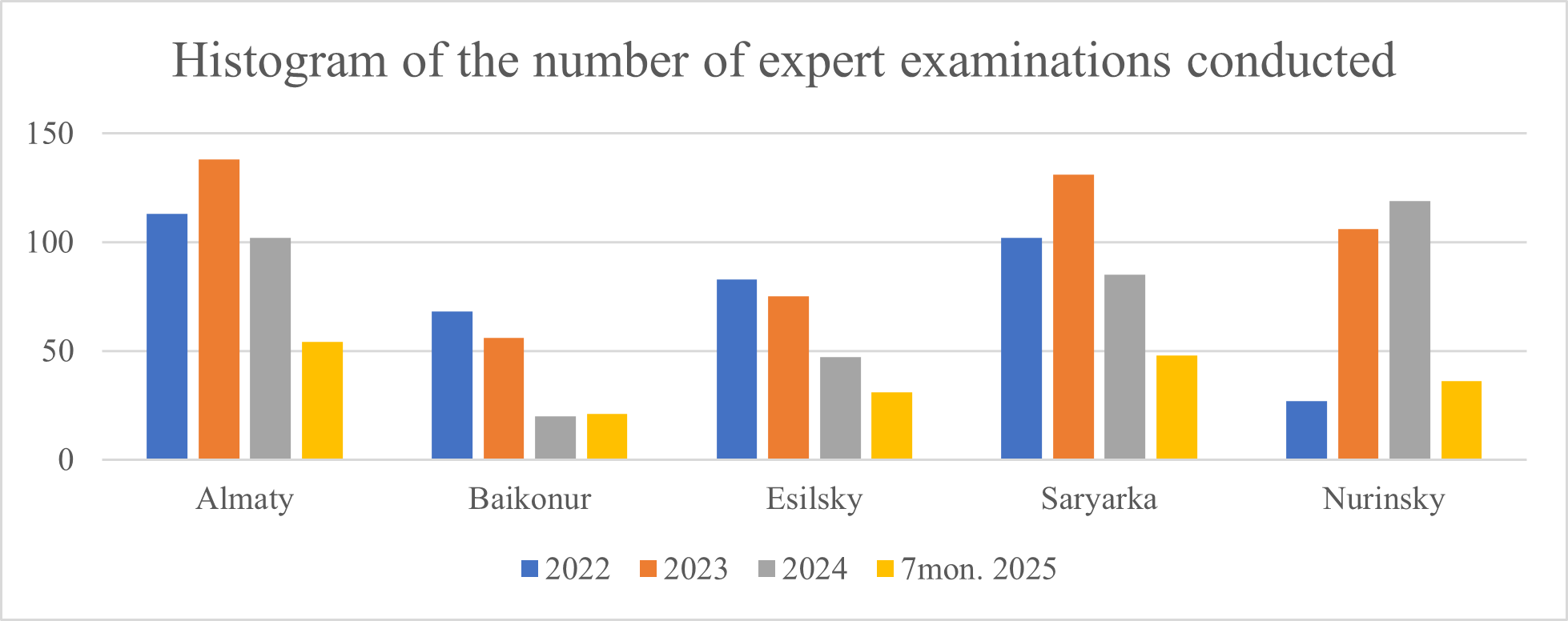
Between 2022 and July 2025, expert assessments related to domestic violence were conducted in the Almaty, Baikonur, Esil, Saryarka, and Nurinsky districts. In 2022, the number of examinations was as follows: Almaty — 113, Baikonur — 68, Esil — 83, Saryarka — 102, Nur — 27. In 2023, an increase was observed in most districts: Almaty — 138, Baikonur — 56, Esil — 75, Saryarka — 131, Nurinsky — 106. In 2024, the numbers dropped in Almaty (102), Baikonur (20), Esil (47), and Saryarka (85) districts, but increased in Nurinsky — up to 119 examinations. For the first 7 months of 2025, the following were registered: Almaty — 54, Baikonur — 21, Esil — 31, Saryarka — 48, Nurinsky — 36 (see Fig. 3).
An analysis of statistical data from the Central Statistical Agency of the Ministry of Justice of the Republic of Kazakhstan for the city of Astana reveals an alarming trend: in recent years, against the backdrop of an overall increase in cases of domestic violence, the proportion of child victims has risen significantly.
At the same time, it should be noted that most cases of domestic violence are accompanied by physical injuries of varying severity, requiring both medical care and subsequent forensic medical examination to establish the nature, mechanism, and severity of the injuries.
In this regard, the importance of timely and accurate medical documentation is increasing, especially in the context of process automation. EMCs containing structured data on diagnosis, treatment, and patient dynamics can serve as a key source of evidence in forensic medical examinations, including the assessment of bodily injuries caused by domestic violence.
Despite the high significance of EMC in expert practice, there are still no systematic studies in domestic scientific and expert literature devoted to their role and legal validity in the context of forensic medical assessment of bodily injuries. There are some publications on the legal validity of electronic documents in legal practice[3], as well as on the reliability of primary medical documentation[4], but they do not focus on the specifics of using EMDs in cases of domestic violence, where multiple, repeated injuries are often recorded, often with elements of concealment of the circumstances of the incident.
In addition, the issue of standardizing EMC records and their suitability for subsequent expert analysis remains unresolved. In the practical work of forensic medical experts, there are cases where incomplete or formally entered information in the EMC makes it difficult to conduct an objective examination and legal qualification of actions.
Thus, there is an obvious gap in the scientific development of criteria and methodological approaches to the use of EMC in forensic medical examination of bodily injuries resulting from domestic violence.
The purpose of this study is to analyze the role and significance of electronic medical records in the process of forensic medical assessment of bodily injuries resulting from domestic violence, taking into account Kazakhstani legal and medical practice. The study plans to identify existing problems in the use of electronic medical records in expert activities, assess their informativeness and legal validity, and propose ways to optimize their use in forensic medical examination.
Materials and methods. This study was conducted as a retrospective descriptive analysis covering 1,462 cases of forensic medical examination of bodily injuries caused by domestic violence, conducted in 2022-2024 and the first seven months of 2025 at the Forensic Medical Examination Center of the Ministry of Justice of the Republic of Kazakhstan in the city of Astana. The study included cases in which the victims received medical care on an outpatient or inpatient basis, with the mandatory presence of an EMC containing records of the diagnosis, nature of the injury, examination results, treatment methods, and dynamics of the condition.
Inclusion criteria: confirmed fact of domestic violence (based on case materials), presence of bodily injuries, and availability of a complete EMC. Cases with missing or technically inaccessible EMC, incomplete documentation, or where the examination data did not allow for an objective determination of the severity or mechanism of the injury were excluded.
As part of the study, a content analysis of the EMC records was conducted and compared with the conclusions of forensic medical examinations. The completeness, structure, chronology, and legal suitability of the data were evaluated. In addition, the correlation between the quality of the information in the EMC and the accuracy of the expert conclusions was analyzed. Statistical processing was performed using descriptive statistics and correlation analysis (Pearson’s coefficient) to identify relationships between the quality of medical documentation and expert assessment. The study complied with the basic ethical principles enshrined in the World Medical Association’s Declaration of Helsinki[5], and all personal data was anonymized in accordance with the requirements of the Republic of Kazakhstan’s legislation on the protection of personal data[6].
Results. The study included 1,462 cases of forensic medical examination related to domestic violence, for which electronic medical records (EMRs) were available. Of these, 1,303 cases (89.1%) involved women and 79 (5.4%) involved children. The average age of the victims was 34.2 ± 9.5 years. In 1,340 cases (91.6%), the violence occurred at home, while in 122 cases (8.4%), it occurred in other circumstances classified as domestic based on the investigation materials.
- Completeness and structure of the EMC
Based on the results of the content analysis of the EMC, the following was established:
- In 1,175 cases (80.4%), the EMC contained a complete description of the anatomical location and nature of the bodily injuries;
- In 769 cases (52.6%), there were photographs or attached diagrams;
- In 392 cases (26.8%), there were no time stamps for the examination (time of injury, time of treatment, time of examination);
- In 513 cases (35.1%), there were discrepancies between the description of injuries in the EMC and in the expert opinion.
Table 1
Structure and completeness of the EMC according to key criteria (n = 97)
| Indicator | n | % |
| Full description of the location of injuries | 1175 | 80,4 % |
| Availability of photographs/diagrams | 769 | 52,6 % |
| Indication of time stamps | 1070 | 73,2 % |
| Signature and identification of the physician | 1402 | 95,9 % |
| Discrepancy with the expert’s conclusion | 513 | 35,1 % |
- The impact of EMC quality on expert conclusions
An analysis of expert conclusions revealed that in 1,025 cases (70.1%), the completeness and structure of the EMC directly contributed to a more accurate classification of bodily injuries according to their severity in accordance with Articles 107-109 of the Criminal Code of the Republic of Kazakhstan (hereinafter referred to as the Criminal Code of the Republic of Kazakhstan)[7]. In 437 cases (29.9%), where the EMC was incomplete, the experts pointed to the need for additional clinical data or noted the impossibility of making unambiguous conclusions without additional medical verification.
Correlation analysis showed a statistically significant relationship between the level of completeness of the EMC and the degree of clarity and validity of expert conclusions (Pearson’s coefficient r = 0.71, p < 0.01).
- Time characteristics
The average time from the moment of injury to seeking medical attention was 8.4 ± 4.2 hours. In 934 cases (63.9%), victims sought help within the first 6 hours, while in 528 cases (36.1%), they sought help later. Later treatment had a statistically significant effect on the completeness and reliability of the data recorded in the EMC, especially in cases of superficial bodily injuries, abrasions, or the initial stages of hematoma formation, the visual signs of which could partially disappear or change.
Discussion. The results of the study confirmed that EMFs play an important role in the forensic medical assessment of bodily injuries, especially in cases related to domestic violence. The availability of a fully completed EMC with structured data greatly facilitates the expert’s task of classifying injuries according to their severity, as well as establishing a causal link between the described clinical signs and the mechanism of injury. The positive correlation found between the completeness of the EMC and the certainty of the expert opinion (r = 0.71, p < 0.01) confirms the practical significance of standardizing digital medical documentation for the purposes of forensic medicine.
Based on the analysis, the following conclusions can be drawn:
- The lack of uniform standards for maintaining electronic medical records, as well as the insufficient level of digital literacy among medical professionals, significantly reduce the legal significance of electronic medical documentation in court proceedings, in particular, in the conduct of forensic medical examinations of bodily injuries caused as a result of domestic violence.
- In 40% of cases of forensic medical examinations in Astana, experts encountered incomplete or missing objective data in EMD, which directly affected the ability to classify bodily injuries according to their severity and complicated the process of establishing the mechanism of injury and the temporal characteristics of the incident.
- A comparative analysis of the EMC and expert conclusions revealed discrepancies in 36.1% of cases, which may be due to a number of technical (shortcomings in medical information systems, lack of photographic documentation) and organizational factors (incorrect or formal data entry, high workload on doctors during emergency visits). These discrepancies reduce the evidential value of EMC as a source of information in expert practice.
The strength of our study lies in the use of real forensic material and the inclusion of a wide range of medical institutions where EMC were issued, which ensures the external validity of the conclusions. In addition, statistical processing made it possible to establish a reliable correlation between the quality of EMC and the accuracy of expert assessment.
It should also be noted that in practice, there are often cases when emergency hospital doctors limit themselves to entering a minimum amount of information into the EMC, especially in emergency situations or when the circumstances of the injury are unclear. Such incompleteness reduces the evidential value of the records and makes it difficult to use them in forensic medical examinations.
Based on the study, it can be concluded that EMRs are a significant source of information for forensic medical assessment of bodily injuries related to domestic violence, but their evidentiary value depends significantly on the completeness, structure, and timeliness of data entry. The lack of uniform standards for maintaining electronic medical records, as well as the insufficient level of digital training of medical workers, including in emergency hospitals, leads to significant gaps in documentation, which in 36.1 percent of cases is reflected in discrepancies between the records in the EMC and the data obtained during forensic medical examination. It was found that in 40 percent of the examinations conducted in Astana, experts encountered incomplete or missing objective information in medical records, which made it difficult to classify bodily injuries according to their severity and complicated the determination of the mechanism of injury. The results confirm the need to develop and implement national regulations on the standardization of forensic medical examinations, taking into account the needs of forensic medical practice, as well as to improve the digital literacy of medical workers directly involved in providing primary and emergency medical care to victims of domestic violence.
Conclusion. Based on the study, it seems appropriate to:
- Develop and implement, within the framework of the Ministry of Health of the Republic of Kazakhstan, mandatory clinical minimum requirements for completing the EMC section related to violent trauma, including: precise anatomical localization, size, color, nature of injuries, mandatory photo documentation with a scale ruler, time stamps of injury and examination.
- Make appropriate changes to the instructions and clinical protocols for doctors in emergency rooms and trauma centers.
- Develop and implement training programs for medical workers, explaining the legal significance of each element of the EMC record for subsequent judicial investigation.
References
- Постановление Правительства Республики Казахстан № 269 «Об утверждении Концепции цифровой трансформации, развития отрасли информационно-коммуникационных технологий и кибербезопасности на 2023-2029 годы» от 28 марта 2023 года // https://adilet.zan.kz/rus/docs/P2300000269 (дата обращения: 01.08.2025).
- Отчет Центра судебной экспертизы Министерства юстиции Республики Казахстан судебно-медицинских экспертиз, связанная с семейно-бытовым насилием. — Астана, 2025.
- Полякова Т. А., Зимин И. В. Актуальные проблемы правового обеспечения юридической значимости электронных документов // Право. Журнал Высшей школы экономики. — 2012. — № 2 // https://cyberleninka.ru/article/n/aktualnye-problemy-pravovogo-obespecheniya-yuridicheskoy-znachimosti-elektronnyh-dokumentov (дата обращения: 02.08.2025).
- Шмаров Л. А. Актуальные вопросы экспертных ошибок и оценки качества выполнения судебно-медицинских экспертиз по материалам публикаций в журнале «Судебно-медицинская экспертиза» за период с 1958 по 2015 г. // Судебно-медицинская экспертиза. — 2017. — № 1. — С. 51-55. DOI: 10.17116/sudmed201760151-55.
- Хельсинкская декларация Всемирной Медицинской Ассоциации // https://online.zakon.kz/Document/?doc_id=31638326&pos=6;-108#pos=6;-108 (дата обращения: 02.08.2025)
- Закон Республики Казахстан № 94-V «О персональных данных и их защите» от 21 мая 2013 года // https://adilet.zan.kz/rus/docs/Z1300000094 (дата обращения: 02.08.2025).
- Уголовный кодекс Республики Казахстан № 226-V ЗРК от 3 июля 2014 года. // https://adilet.zan.kz/rus/docs/K1400000226/k226_.htm (дата обращения: 02.08.2025)
Spisok literatury / References
- Postanovlenie Pravitelstva Respubliki Kazakhstan № 269 «Ob utverzhdenii Kontseptsii tsifrovoy transformatsii, razvitiya otrasli informatsionno-kommunikatsionnykh tekhnologiy i kiberbezopasnosti na 2023-2029 gody» ot 28 marta 2023 goda // https://adilet.zan.kz/rus/docs/P2300000269 (data obrashcheniya: 01.08.2025)
- Otchet Tsentra sudebnoy ekspertizy Ministerstva yustitsii Respubliki Kazakhstan sudebno-meditsinskikh ekspertiz, svyazannaya s semeyno-bytovym nasiliem. — Astana, 2025.
- Polyakova T. A., Zimin I. V. Aktualnye problemy pravovogo obespecheniya yuridicheskoy znachimosti elektronnykh dokumentov // Pravo. Zhurnal Vysshey shkoly ekonomiki. — 2012. — № 2 // https://cyberleninka.ru/article/n/aktualnye-problemy-pravovogo-obespecheniya-yuridicheskoy-znachimosti-elektronnyh-dokumentov (data obrashcheniya: 02.08.2025).
- Shmarov L. A. Aktualnye voprosy ekspertnykh oshibok i otsenki kachestva vypolneniya sudebno-meditsinskikh ekspertiz po materialam publikatsiy v zhurnale «Sudebno-meditsinskaya ekspertiza» za period s 1958 po 2015 g. // Sudebno-meditsinskaya ekspertiza. — 2017. — № 1. — S. 51-55. DOI: 10.17116/sudmed201760151-55.
- Khelsinkskaya deklaratsiya Vsemirnoy Meditsinskoy Assotsiatsii // https://online.zakon.kz/Document/?doc_id=31638326&pos=6;-108#pos=6;-108 (data obrashcheniya: 02.08.2025)
- Zakon Respubliki Kazakhstan N 94-V «O personalnykh dannykh i ikh zashchite» ot 21 maya 2013 goda // https://adilet.zan.kz/rus/docs/Z1300000094 (data obrashcheniya: 02.08.2025)
- Ugolovnyy kodeks Respubliki Kazakhstan № 226-V ZRK ot 3 iyulya 2014 goda // https://adilet.zan.kz/rus/docs/K1400000226/k226_.htm (data obrashcheniya: 02.08.2025)